WINNER, FALL 2025
The Ghost Story Supernatural Fiction Award
BY JOSEPH BATHANTI
The third and final time my mother and I visit Graziella, a brown whip-thin man without thumbs sits at her kitchen table: eyes closed, four-fingered palms spliced together beneath an exaggerated sickle nose and chopped black mustache—nostrils tunneling endlessly into the classified vaults of his memory. His bald crown glows clairvoyantly. From his colossal, hairy, near-bestial ears dangle earrings of bloodstone—a gem to protect warriors and guard against evil spirits.
Graziella gestures grandly toward the man and pronounces, “Questo e Kesh.”
Kesh opens his bright black eyes—an archive of light and horror—and smiles. Such a charming smile, the mustache above it, smoky broken teeth, the suffering and forbearance of his aged mouth. You must smile, no matter what, insists the smile.
He rises and paces to my mother. Outlandishly tall, he wears a pale-yellow linen suit, white shirt with bloodstone cuff links, a lavender hand-painted J. Galet necktie emblazoned with swooping crows. No shoes. Barefoot. His black-banded yellow straw fedora reposes upon the table.
“Hello, Kesh,” my mother says.
“Rita.” Kesh emphasizes both syllables. His voice, a tremulous whisper, reverberates as if it has traveled a long way over the years to reach my mother, from a place only Kesh reckons—a place that no longer exits, a place my mother can only imagine.
They kiss ceremoniously—both cheeks—as if initiating a pact.
He looks down at me from what seems the ceiling and extends a massive, veined hand—an old, suddenly unearthed hand like a mason trowel—that hosts rivers, chasms, terrain long-vanished. I place within that plat, those inscrutable divagations, my small white sparrow hand. Kesh’s long brown fingers fold it into his palm, and he gently holds it. Where the thumb had been shines a pale, smooth declivity.
“What is your name?” he asks.
“Fritz.”
“Fritz,” he says, and smiles all the more.
“Frederick,” my mother says. “Fritz is short for Frederick.”
“Federico,” says Graziella.
My mother’s father—my namesake, Federico, burnt up in a fire—had also paid homage to Graziella. Long ago. Before my mother. Before anything. Perhaps there had been more. There’s always more.
Kesh nods solemnly. When he resumes his seat, and releases my hand, my mother and Graziella sit. Kesh looks at me and says, “Fritz,” motions to the vacant fourth chair, and I sit. My name, issued from his mouth, has a memory beyond its single syllable. “Frederick is from the German, Friedrich,” says Kesh. “It means peaceful ruler. Where I come from, your name is Fridrik.” He doesn’t say where he comes from, but the sound of my name in his native tongue sounds like City Bitch. He notices I’m slightly taken aback. “Fritz is very strong,” he declares, lays his hand upon my shoulder for an instant, looks deeply into my eyes, then says, again, to reassure me: “Fritz.”
My mother and Graziella gaze in awe at Kesh, as if he’s just laid bare a precious truth.
My mother comes in secret to Graziella—to pay tribute, yes; but, more importantly, to seek counsel dire about how to conceive. Her womb has been driven mad with insatiable longing. When she is under the spell of that desire, she is wholly unpredictable. She brandishes kitchen knives and threatens murder. Gathers broken robin eggs and crow feathers. Refuses to speak to my father and me. Today she is restrained, almost shy—a placid, reasonable version of herself—and unmistakably younger. Her teeth and complexion. Her hair: an innocent bundle of shimmering gold. She wears perfume and smiles, nearly overcome at the presence of Kesh, as if he’s returned from the spirit world.
Graziella, a hunched, gnarled slip of smoke, has been old for a century. Perhaps dead. Morta. A cadre of aged Italian people wandering East Liberty must be dead. In recollection, there has never been an East Liberty without Graziella. She is not fond of me. I’ve thrown buckeyes at her insulbrick shack on Shakespeare Street, and I fret that her sole interest in helping my mother conceive is to supplant me with the new better boy she will animate in my mother’s womb. I want a sister. My mother wants only boys. She has not had this conversation about boy or girl with my father, but he is aware of her dramatic preference. He’d rather I remain the only boy. Graziella, unable to persuade a baby to roost in my mother, has summoned Kesh.
My father does not discount metaphysics, the arcane, even the occult. He understands that another realm exists, beyond our ken, but he insists on living, minute to minute, in the reliable flesh and blood world, fraught as it is with its own wrenching arsenal of uncanny. He is dismayed at this business with Graziella, this mumbo-jumbo. He’s also troubled, even slightly offended—though my father typically resists taking offense—that my mother is so obsessed with having another child. He does not know we’re here in Graziella’s kitchen. Like me, until this moment, my father has never heard of Kesh.
Today, Graziella, like my mother, seems younger, oddly regal—as if she’s swallowed some inspiriting decoction. Draped about her head—instead of her habitual black widow’s cap—rustles a soft rose veil, above a white dress, that falls in tiers about her tiny skeleton. She smiles at me, pats my hand, places on the table demitasses of tarry black ristretto and a platter of wandi, a delicate cookie fried in twisted, rag-like shapes, dusted with powdered sugar.
“Mangiare,” says Graziella.
My mother glances at me. She wants me to have a cookie, two or three, to show respect for Graziella. But I’m wary. To taste this divine cookie poses grave risk. Graziella is the acknowledged East Liberty strega, impresaria of curses: the evil eye, the malocchio; potions; spells; prognostication. And there are the buckeyes I’ve thrown off her tin roof and the matter of vendetta. The wandi glisten seductively in the sudden bolt of sun impaling the kitchen.
My mother, as is her practice, bears gifts for Graziella: lavish chocolates—from Bolan’s, no less—and a quart of Isaly’s Rainbow ice cream. And, most strategic: Old Gold cigarettes. Complementi, Omaggio, Graziella calls such alms. Today is a three-carton-two-pound-box-of-Bolan’s-Rainbow visit. Graziella leaves untouched the candy and ice cream but rips into the Old Golds and pries out a glistening white packet, Old Gold emblazoned in big red print and, at its crest, an ebony field with a gold crown. She slices open the seal with a blade-like fingernail, nocks a cigarette in her pleated gray lips, and turns to my mother, who produces a gorgeous enamel Colibri lighter that my father and I presented her with on Mother’s Day. He and I had been in Moe’s Original, on Station Street, eating hot dogs. A guy my dad knows, Primo Sandhagen, perched at the counter with a hot dog and a white Stagno’s Bakery bag of hot fancy lighters at cut-rate prices. John Kennedy, while president, ate a hotdog at Moe’s. There’s a picture, over the grill, of him eating it.
My mother conjures fire from the Colibri and steadies it for Graziella, selects a cigarette from her own packet of Chesterfields and lights it from the same flame.
Graziella offers an Old Gold to Kesh.
“Thank you, but no, I’m afraid,” he says, miters together his thumbless hands, smiles and bows over them, then drains his ristretto in a single flourish.
Imagine the kitchen of a strega. Bat skulls. Urns of brackish broth. Rowed mason jars of herb and fetish. Stoppered cruets of ambered reliquary. A crucifix; sick box; cameos of bloody saints trussed in Easter palm; a Holy Water stoop; a lone parched ancient book, The Recipes of Saint Maria Goretti. As well as the unimaginable largesse of the huckster’s wagon: blinding grapes, eggplant, escarole, arugula, cicoria. Artichokes. Peaches, apricots, plums, cherries. Slender, sweet orange, yellow and blood-red peppers—friggitelli—seductive as Sophia Loren. Tentacles of plants writhe throughout the house.
Beyond the open screen door buzz hosts of carpenter bees gorging nectar from lavish purple Russian sage. A banana tree thrives in the soot yard. The crippled buckeye tree is in full bloom, its leaves bright green in clustered leaflets—though it will not fruit and loose its pods until autumn, when the new baby, my brother, has taken up inside my mother.
Graziella’s kitchen ceiling is Blessed Mother blue. Wreaths of cigarette smoke whirl and assume, in relief against the ceiling, the oracular shape of cumulonimbi.
“Kesh was in the war,” says my mother.
Graziella nods gravely and I do my best to acknowledge this revelation without uttering a word.
Kesh had been an interpreter, a spy, una spia, on the side of the Allies. He saved the lives of many American soldiers by sharing tabu information. The Gestapo captured him and cut off his thumbs. This is what I glean from the conversation between my mother and Graziella—a matrix of my mother’s butchered Italian and Graziella’s butchered English. Kesh merely looks on in contemplative, bemused silence as if having had his thumbs hacked off is a mere hindrance. He smiles and gestures at the wandi.
“Mangiare,” says Graziella.
Kesh and my mother each take a cookie. The wandi snap in their teeth. They close their eyes and chew in ecstasy.
Graziella stands, picks up the platter and proffers it to me. “Mangiare.”
My mother’s glance is now unmistakable. In the center of her matchless brown eyes surfaces pinpricks of red that pulse with her will. I am faced with a perhaps-cursed cookie or my mother’s certain displeasure at my disrespect—disgrazia—especially in front of Kesh—which might assume any number of tactics and stretch for who knows how long.
“They’re delicious,” says my mother.
“Ladhidh,” says Kesh.
Graziella shadows me with the platter. Her veil flutters in the breeze, rife with lavender. It brushes my cheek.
The wandi, wrought in coils, await. White powder cloaks them. I examine each as long as I am able—my mother’s eyes glow scarlet—then choose the least like shrapnel, bring it to my mouth, and bite. Sugar sprays my nose and chin. The cookie is indeed ladhidh and, as I chew and swallow and take another bite, I feel a great peace. Heaven caresses me and I fight back tears of joy.
“Che bella,” pronounces Graziella, claps her hands like a little girl, chortles and kisses the top of my head. In my hair, her lips weave a nest.
My mother’s eyes return to plush brown. She and Kesh smile knowingly, as if I have fulfilled a promise foretold. I bolt down my ristretto, in the manner of Kesh, and they all laugh.
Suddenly, from beneath his chair, Kesh produces a package wrapped in heavy peach paper, fastened in a crux of red twine. He nudges it across the table to my mother. She clutches it to her breast.
Graziella again nods gravely and whispers: “Dio Mio.”
The three of them, without a word, disappear into Graziella’s bed chamber and close the door.
Everything is instantly silent. The birds still their song. Not a speck of sound from behind the closed bedroom door. I contemplate the wandi, now in my stomach, those left on the platter beckoning. I eat another and experience the same unadulterated joy and, because I am alone, I permit myself an instant to soundlessly weep. Yet I cannot resist the suspicion that these exquisite cookies are a ruse—vengeance for the buckeyes I’ve fired against Graziella’s rickety walls. In this very kitchen, I’ve witnessed Graziella transmute chocolate cordial cherries into buckeyes; then smile graciously and offer unwitting, yet guilty, me the pound box my mother had brought as alms that day—and cigarettes, too, but not Old Golds; and no ice cream. I am a fool to have eaten the wandi. A plate will sprout in my head; Ace Sosso—the war hero barkeep at Happy’s on Forbes Avenue—has one, sometimes visible, beneath his black trickle of hair, when the light is favorable. I’ll be cast into Basa La Vallone, The Hollow, where the mostro, Spacaluccio, drools in the rafters of the Meadow Street Bridge. My voice will morph into the bray of a ciuccio.
Inexplicably, I am seized with a desperate desire for a cigarette, though I have never smoked one. I snatch one of Graziella’s Old Golds and engage the Colibri: a swaying flame appears like a genie. I commingle the Old Gold’s breath with mine and feel yet again that same ineffable joy engendered by the wandi. Kesh’s fedora lifts in the warm breeze through the screen door, for a moment levitates, then comes to rest at my fingertips. I take it by its pinch and turn it over, gaze into the liner’s deep well from which the aroma of oud and rose waft from the glossy satin-locked seal upon which is imprinted a sprig of Arabian jasmine hovering a cracked gold chalice imprinted with Arabic runes.
I exhale a pouch of smoke, plop upon my head the hat, rise and stroll to the door behind which Kesh, my mother and Graziella have disappeared. Solemn indecipherable petitions—perhaps in Italian, perhaps in another tongue of intercession—chant from beneath the jamb. I cross into the shrunken parlor: cobwebs, parchments of dust, unraveling flocked wallpaper vexed with bloated cherubim, a few sticks of furniture draped in xanthous shrouds, a cloudy mirror above a mantel upon which squats a lidded onyx urn, filled with ash and a gorged fist of hundred-dollar bills. Thank God, I remain untempted to snag a couple of C-notes; Graziella has gauged every molecule of her haunted realm. She’d know if an atom went missing, a grain of rice, a chromosome. She’d cast the eyes on the thief. I’ve imperiled myself enough this summer afternoon. Again, thank God. But I ponder whose ashes these are. Federico’s? I take two drags from the Old Gold, so happy I sigh, and from my mouth unfurls an ibis shaft of smoke. Though I know it is a mistake, I chance a glimpse at my reflection in the mirror: Kesh’s hat tilts at a rakish angle above my right eye and the first augur of whiskers darkens my face. I glance at my fingers. Both thumbs still there, but shoots of black hair crawl the backs of my hands.
I am seated at the kitchen table when my mother, Kesh and Graziella emerge. Entranced, barefoot, my mother wears a slender, madras blush-pink dress, perfumed with oud; a sleeve of frankincense mist attends her. Three pearl buttons fasten at her throat, two more at the white cuffs encircling her wrists. Her hair is chopped to a boy’s, shorter than mine. Enormous caffe eyes pool in her sockets. From her lobes depend Kesh’s bloodstone earrings. My cigarette butt lies across the others snuffed in the ashtray.
They sit. My mother reaches across the table and takes my hand for a moment—this suddenly unfamiliar hand of mine. I have no recollection of my hand in my mother’s, but of course she would have held my hand when I was a little boy. Then she says “Fritz” and smiles so beatifically. She has that scrubbed-clean-soon-to-be-martyred-brainwashed look: St. Rita Schiaretta Sweeney of East Liberty, patron saint of desire and loathing.
In the tiny withered scale of her palm, Graziella places the Old Gold packet, calibrates its weight, then simply fixes me in her gaze—not in anger, but a smug, pleated smirk—long enough to convince me that there can never be a secret between us and I’m even more terrified of her because I yearn for her love and, for the love of Christ, I dare to smile. Her wandi abide in me now. I should have known better.
Kesh reckons perfectly what has just occurred. He raises his right hand to me, a supplicant mammoth hand, a thumbless pinion hand, in benediction. “So, you fancy my hat, Fritz?”
I’ve completely forgotten the hat. I sweep it from my head and hand it to Kesh. “I’m sorry,” I say.
He turns it over and over—crown, brim, eyelets, the liner that thatches his head and holds within it, I’m sure, the secrets of all that will come to pass. He smiles and, with both hands, places upon my head this sacred fedora. “The hat fancies you, Fritz. It is now yours, and may you be blessed by it.”
Graziella makes the Sign of the Cross.
“You’ll be an older brother soon, Fritz,” pronounces Kesh.
My mother seems hallucinating. She smiles pacifically as Kesh removes from his inner suitcoat pocket a slender lined ledger and a blue fountain pen and explains that she must wear the dress until the night she conceives, that my father must remove it from her during the Strawberry Moon—the June full moon—mere days away—when it is at its fullest-golden-crimson-spilling-over-fecundity. As he speaks, he writes in ornate penmanship these very instructions—pen threaded among his four fingers—tears the page from its coil and hands it to me. “You, Fritz,” he says, “must present these instructions to your father. He’ll know what to do.”
“Kesh,” I implore. At the sound of his name for the first time in my mouth, I feel lighter, as if I’m floating from the chair, and there is a palpable pulse in the crown of my new hat.
“Do not fret, Fritz. Your father will understand perfectly. All will be well. I promise. I’m never far away.” Kesh again rests a hand on my shoulder. His opal eyes glow green, punctuated with red ellipses, like bloodstone. “Now, you must hold your mother’s hand and take her home. Inshallah.”
Graziella again makes the Sign of the Cross.
“Mom,” I say. “It’s time to go home.”
My mother stands. “Take my hand,” she says, reaching again for mine.
I rise and take her hand.
I will see my mother again, some years later, in this dress, my father on his knees before her, but my memory of this very afternoon in Graziella’s kitchen, will be erased—as certain memories evanesce over time or simply commit themselves to falsehood.
Graziella and Kesh ascend from their chairs.
My mother and Kesh kiss on both cheeks.
My mother and Graziella kiss on both cheeks.
Kesh and I kiss on both cheeks.
Graziella and I kiss on both cheeks.
The kitchen panes stream dying light. Ice cream melts in rainbow runnels across the table and drips to the floor.
____________________________________________________________________________________
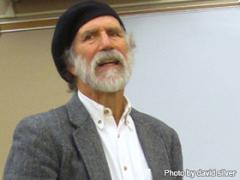 Joseph Bathanti is the former North Carolina Poet Laureate (2012-14) and recipient of the North Carolina Award in Literature, the state’s highest civilian honor. He is the author of 20 books. His latest volume of poetry, Light at the Seam, from LSU Press, won the 2022 Roanoke Chowan Prize, awarded annually by the North Carolina Literary and Historical Association for best book of poetry in a given year, as well as the 2023 Brockman-Campbell Award, given annually by the North Carolina Poetry Society, for the best book of poetry published by a North Carolina poet in the previous year. The Act of Contrition & Other Stories, winner of the Eastover Prize for Fiction, from Eastover Press, was published in July of 2023. His novella, The Stranger, is forthcoming in 2024 from Regal House Press. Bathanti is McFarlane Family Distinguished Professor of Interdisciplinary Education at Appalachian State University in Boone, North Carolina. He served as the 2016 Charles George VA Medical Center Writer-in-Residence in Asheville, NC, and is the co-founder of the Medical Center’s Creative Writing Program. Bahtanti’s flash fiction piece, “Jesus,” won the Summer 2022 Screw Turn Flash Fiction Competition. Author photo: David Silver.